Why Intel x86S Failed
A programmer's dream for simpler x86 programming is now gone

On December 19, 2024, Tom’s Hardware reported that Intel has terminated its x86S initiative. For those of us who had hoped for a cleaner, more streamlined x86 architecture, this was disappointing news—though perhaps not entirely surprising.
Intel’s Troubled Years
Since the rise of AMD’s Ryzen processors, Intel has struggled to produce chips competitive with its rivals. At times, the company failed to improve upon its own previous generations. The derisive phrase “waste of sand” emerged during this era, as Intel not only stalled on lithography advancements but also failed to meaningfully improve its microarchitecture.
The once-celebrated “tick-tock” development model collapsed when 10nm production stalled. Intel found itself reusing 14nm—eventually adding three “+” signs to the process name in a desperate attempt to signal progress. Even the performance-efficient core hybrid model failed to rescue the company, plagued by hardware bugs and scheduler issues.
What x86S Promised
Amid these struggles, Intel offered some genuinely good news to firmware and operating system developers in April 2023: the x86S specification. The company continued updating the documentation through October 2024, reaching version 1.2 (all versions remain available here).
So why was x86S considered a blessing for programmers?
Over decades, Intel accumulated legacy instructions in its instruction set architecture to maintain compatibility with ancient code. Features that serve no practical purpose today—Ring 1 and 2, real mode, virtual 8086 mode—still consume silicon real estate despite being obsolete.
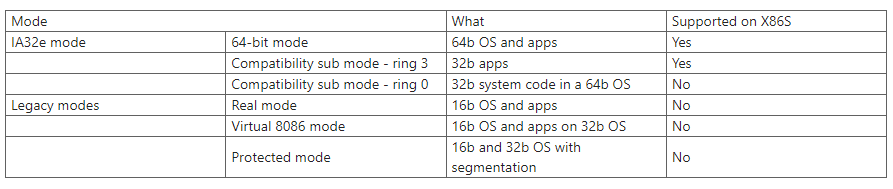
Image retrieved from “Envisioning a Simplified Intel® Architecture”
Consider the modes that x86S would have eliminated: real mode, virtual 8086 mode, and 16-bit protected mode. Unless you’ve delved into extensive assembly references like The Art of 64-bit Assembly, you may never have encountered these relics. And unless you’re running 32-bit operating systems on 64-bit hardware for some unusual reason, they represent nothing but wasted transistors.
Even the “compatibility sub-mode for Ring 0”—designed for 32-bit system code in a 64-bit OS—has become redundant. Both Windows and Linux now strictly prohibit 32-bit device drivers.
The Cost of Legacy
These legacy features don’t just waste silicon. They actively confuse newcomers to assembly programming. When I worked through The Art of 64-bit Assembly, I spent considerable time wrestling with AMD64’s legacy concepts like RIP-relative addressing—knowledge that proved more historical than practical.

Image retrieved from “Envisioning a Simplified Intel® Architecture”
The legacy ISA also complicates bootloader development. Consider FreeBSD’s bootloader: the entire file stand/i386/libi386/amd64_tramp.S exists solely to switch into 64-bit (long) mode. ARM64 and RISC-V bootloaders require no such ceremony. For anyone trying to understand modern bootloader mechanics on Intel hardware, this complexity offers no educational value—only frustration.
Why x86S Died
The initiative’s failure comes down to two factors.
Intel is in financial crisis. The collapse of next-generation lithography and microarchitecture development forced massive layoffs and a retreat to existing projects. New initiatives like x86S couldn’t compete for resources against more immediate priorities.
The business case was weak. Implementing x86S would require rewriting bootloaders to operate in 64-bit mode from startup. Any kernels containing 32-bit device drivers (admittedly rare) would need modification. Then comes internal testing, beta programs, and external validation.
What tangible benefit would users and enterprises receive? Yes, x86S would reduce headaches for programmers—but to corporate decision-makers, that’s simply not compelling enough to justify the investment.
Looking Forward
The silver lining: you likely won’t need to work with Intel’s 64-bit bootloader code very often these days. If you want to understand how bootloaders actually work, ARM and RISC-V implementations offer cleaner, more instructive examples.
And honestly? Those architectures are where the future opportunities lie anyway.
What’s your take on x86S cancellation? Share your thoughts in the comments below.